Showing posts with label gathering methods. Show all posts

Thursday, December 6, 2007

Summer's Hunt


It's cold now, the insects are gone. I can only anticipate more hunts next year and recall this setting of past strivings; the epic struggles between a determined human hunter and a host of highly-evolved flying insects.

Man Eating Bugs, the impressive ‘picture-book’ by Menzel and D’Alusio that illustrates worldwide entomophagy, includes dragonfly hunting on the exotic island of Bali. The people there call them ‘sky prawns,’ which is significant. I knew I’d have to go get some, and that the hunt would be hard work. I once read about a simple way to catch dragonflies – pluck them while they rest on branch-tips over little streams at night. But I’ve never found them that way. It would be either stalk/charge/swing-the-net or nothing.

This made the hunt the most labor-intensive I’ve executed. Some would say more laborious than the prey is worth but if I started listening to the voice of reason I might be tempted to give up on entomophagy altogether, and hat would be a crying shame.

The Indonesian method was similar, but craftier. The hunter [generally kids] would visit the ponds and paddies frequented by dragonflies. The tool of choice: a considerable length of reed, the end of which coated in sticky tree sap. This would be held out like a perch and yet flicked at the right moment, taking an insect while on the wing.


My technique: Iaido-style. The haft is held down and to my left, across the body, double-handed. Having sighted my target, I approach stiffly, one footfall at a time. I would keep my eyes locked (not always as easy, especially when another target would interpose) until the moment to swing the net. Once I learned to swing just above the insect's resting position I could sometimes see it rise into the net's apeture, but at least as often I saw it sail away over or beyond the net. My average was not very impressive but I improved.


The documentation: minimal, merely these words and images. I've been obliged to work alone so there’s no one to hold a camera. I took these pictures so I'm not in them. I probably looked so ridiculous out there that only motion picture [a la Youtube] would have done it justice.


The results: not too bad.


I haven't done much to identify them; this bothers me a little, since, given how little is known about which insect species are edible and which aren't, it would be useful to have a lock on what I plan to eat or to serve to the public. But I've spoken with an expert or two, and there seems to be no records of any toxic in dragonflies North America. So that's reassuring.

I did get some large grasshoppers along the way. They're much easier to identify, by and large, when it comes to that: they're Dissosteira carolina and they're not easy to catch. In fact before I developed my own technique I looked really silly chasing them across the field as I missed getting them again and again. Once I got my method on, though, things were slightly different: I caught them once in every 5 tries instead of once in every 12, and though I still looked ridiculous it wasn't quite as bad.


There were other good moments out in the field; birds, deer. Once I surprised a young black racer and managed both to get him in the net and then out again in my hands before he could foul the material with his very nasty-smelling cloacal emissions. After admiring him I let him go. After all, this is not a reptile-eating endeavor I’m running here, and I have no interest in taking an animal from the wild as a pet.

The eating: dragonflies taste a bit like burned toast, but the texture is unique.


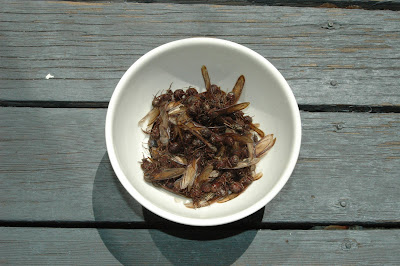
It's no surprise that cooking the dragonflies robs them of some of their delicate perfection. They look pretty good on the plate, but nothing compared to freshly-frozen.

What will I do with these insects now that I've got them? They're available for the contest in Richmond, or for some special order from a customer. And I'll probably experiment with a preparation or two as well.

Wednesday, July 18, 2007

A Colony Attacked


This might not seem a dramatic image. It was the site of a great catastrophe, at least from the perspective of the carpenter ant colony that lived there. I am what befell that colony.


I'd first turned over the log on impulse, and replaced it carefully when I found a seething mass of large, winged black ants. I returned the next day and a few times after that over the next four or five days. The ants were members of the genus Camponotus, a.k.a. carpenter ants. I've known for some time that people have eaten these ants here and there; supposedly lumberjacks in 19th Century Maine ate them to avoid scurvy.

I'd envisioned a "clean kill," meaning a labor-efficient harvest wherein I could harvest the insects only. It didn't work out that way, mostly because the ants had no interest in being harvested and therefore tried to run away very quickly. And it's true that that seething business rattled me; I knew that the ants couldn't hurt me, it was just that as I was scrambling to collect as many as I could, this is what I ended up with:


A whole lot of wood bits, dead leaves, and some soil, with a good deal of ant-made sawdust. It required a good deal of processing. I would've liked to document this process, but the sad truth about both this blog and much of my work in entomophagy is that I do a lot of it alone so there's no one to hold the camera.

I had about six or sevent containers from my various raids; some had this litter from the forest floor; in others it was mostly sawdust from inside the log. I found that sifting the mix in large bowls worked quite well, reminiscent of the old-fashioned wheat-from-chaff technique. All of this in order to get to the prize: the pupae.


Of course I'd collected a heck of a lot of ants too, and I was most interested in them also, despite my slight concerns about Wolbachia -- an endosymbiont that wouldn't do me much good if it was in my system. Here's the ants with a few bits of wood [toward the end of the sifting].


And here they are again -- the queen (one of many; methinks the colony, having done well for itself, was about to send a whole raft of winged alates into the the world); some drones; and the necessary workers.


I find the ants quite beautiful, dead or alive. And working on prepping them as food emphasized what I'd felt when I was collecting them at that log -- a touch of guilt.


I thought of the colony as a society or a machine consisting of living parts, each of which pursues its function for the greater good of the whole. This conception is on my mind quite a lot, and it's something that I'm pretty sure I wouldn't find in hunting magazines (if I read them, that is). A "real" hunter, as represented in such publications, respects his or her mission and goal; respects the quarry and the landscape too; honors the kill, but doesn't succumb to any feelings of guilt about having to kill. After all, hunting is simply the involvement of the meat-consumer in the process of getting the meat, and therefore the hunter is more authentic than someone who simply lets others do the killing, and merely picks up the wrapped and sanitized Styrofoam tray in the supermarket. There's a lot to be said about that perspective.

I appreciate the times when I feel this way, which I sometimes do. Other times, though, I have other feelings. When I was collecting cicadas off the trees in New Jersey in 2004 I thought a lot about the fact that these insects had been underground for 17 years, all in order to emerge and mate and die. All of that time in preparation for procreation -- arguably, the prime evolutionary function and purpose of every organism. And here I was, getting in the way of that. Granted, it's not much of a stretch to say that I was acting like any other predator. The mass emergence strategy of these multiple billions of cicadas was an evolutionary response to my actions as much as it was to the actions of birds, snakes, skunks, raccoons, bats, etc. The cicadas are a temporary banquet. "Go ahead," the vast numbers seem to say. "Eat all you want. We'll make more anyway. All of your efforts cannot make much of a dent in our overall numbers." How generous. Yet I remember the mixed feelings as I scooped up dozens of handfuls of live adult, newly-winged cicadas and the just-emerging nymphs into the large ziploc bags that went straight into the large icy cooler.

And so it was with these ants. A nation is attacked by something with greater technology. I don't really need to kill the ants, since I have lots of other foods that I could eat. But I'm trying to make a point here with entomophagy. It's just like other kinds of hunting, right?


Another kind of hunting these days has been for dragonflies (and the odd grasshopper along the way). It's the opposite of 'anting;' for one thing, it requires stalking and netting the individual insect, and so it would seem to be less labor-efficient. Given the way that I've executed this ant project, though, it's a toss-up.

Sunday, July 8, 2007

ANOTHER new edible insect in the mail! The Big Ants

I've been sitting on this pretty amazing news for a little while now, getting ready to blog it, as the kids say. First I’d gotten the chapulines (picked up another 4.5 pounds from the Mexican market just today), then the cicadas, and then these big ants. By the Fall I hope to receive two or three other kinds of insects.

I’d contacted a member of http://www.bugguide.net/, a pretty cool group that posts images of North American insects and other arthropods; identifies the species, collates geographical information, etc, etc. My contact lives in Texas and had posted images of leaf-cutter ants – specifically the alates, meaning the winged reproductives that some types of colony-living insects send out at specific times. In this case that would be, more or less, in the second half of May.

These ants [in the genus Atta] are cherished delicacies in Colombia and other places between there and the U.S. Were it not for concerns about slowing down these posts with lots of extra text I’d cite some intriguing stuff about the Spaniards, when they arrived in what became Colombia, scorning the local caviar, as it was thought of, only to attempt seizing control of the ant colonies once they got a taste for the insects. This decision provoked an uprising from the natives. Those interested in reading this for themselves can find it here.

Though at first that Texas connection wrote that -- had missed the brief emergence-time of those winged queen ants, word later came that -- had been successful after all! Very exciting news.

At length the large box arrived [note my foot for scale, and that I've cleverly obscured the sender's address on the shipping document]


inside was a Styrofoam cooler,


and inside that was OVER TWO POUNDS of ants.


They’re beautiful, impressive insects.


The real question, though: how do they taste? The morning after I got them I laid a few down on a hot iron skillet. I tried both winged and wing-free individuals; unlike those of the cicadas, these wings really did get in the way. The flavor is very nice; surprisingly mild.

I’ve tried these ants before – pre-packaged [and quite expensive.] The flavor is very intense, almost harsh. I’ve heard that fresh off the vendor’s cart in Colombia they’re heavenly (and, again, quite expensive). The ants are still enjoyed today, and are called “hormigas culonas,” or ‘big-bottom ants’ due to their impressive abdomens.

Given that I've greatly enjoyed these ants in other settings, I'm pretty certain that I can make them taste even better.

This item is just the kind of thing that those few discerning customers ask for; the ones who want more from life than the standard crickets and mealworms. When this happens I'm ready.


Also worth mentioning: I've seen one or two websites centered on the harvest and preparation of these ants in Colombia. Not altogether surprisingly, these sites are in Spanish, which I cannot translate. So getting some help with that would be great...


On the other side of the plate are the mopani worms; they shall have their own substantial post at some point.... Boy, would I love to get a source of those!!


As for the Texan ants: my source mentioned having some ideas for, hopefully, an even bigger harvest next Spring.

Tuesday, July 3, 2007

Next Bug: cicadas

Cicadas are the insects people hear more often than see; they're the loud buzzing sound we may associate with summer. When we see them, it's often as a flash -- they're super fast flyers. But they're not so fast when they emerge; they crawl out of the ground in their nymphal shells, climb up a tree or some other nearby vertical [like one's legs, if one stands still for a while], and struggle out of their skins. After that it's still a long while before they can fly. And all of this time is when you can scoop them up by the pound.

Some species live only one year; the periodic cicadas are better known due to their staggering emergences. A predator-response strategy has led the species to stay beneath ground for either 13 or 17 years (depending on the particular species) and then come up more or less at the same time. This allows a range of creatures to eat as many as they want and still allow a good percentage of the insects a chance to reproduce.


And here's a single one:


In 2004 the "famous" Brood X emerged in many states on the Eastern Seaboard; I drove down to Princeton, NJ; slept in my car on campus during Memorial Day weekend; and harvested eight or nine pounds of cicadas from a few massive beech trees on the Princeton campus. I've been serving them -- sauteed or dry-toasted -- to the public ever since. A few images of that event are on my website.

This year it was Brood XIII's turn. They were locally numerous in the Chicago area, and since I couldn't get out there I contacted a professor of Entomology, who knew of a few graduate students -- my official "THANKS" go out to James (Jamie) Zahnisser and his crew of friends -- who were willing to collect some for me. The cicadas arrived a couple of weeks ago.


After a little rinsing, I packed them into the freezer (as I've said before, I've got an understanding wife).


Though the bowl design features "pasta," we should note that insects are basically the protein source of a meal.

Cicadas are found worldwide and are a very popular food. Heck, Aristotle wrote that the last earth-bound stage, before the animal breaks through its thin brown shell, that's the tastiest. He loved them.