Giant Water Bugs [Lethocerus indicus, which for some reason I've barely mentioned in this blog]. I call them 'usual' because they're one of the insects more-or-less easily available in Asian markets in Providence. Though I've seen them served whole-fried in Thailand (I found myself unable to masticate them much at all, I guess my mouth is too tender), I serve them filleted; taking out the muscle tissue in the thorax. Most people are pretty blown away by the taste of it, but some folks just purely hate it.
and the unusual:

Thorny Stick Insects [Eurycantha horridum], which unfortunately are not all that good after all. Not much to eat on them, but they're much appreciated and enjoyed in Papua New Guinea, where they're stuck on a stick and roasted over the fire.
And there was one item that I myself had never tried: house fly pupae.
I'd gotten them last fall, through the kindness of folks at Cornell's Ag department -- thanks again, Allie!! I can admit now that I had a bit of a hang up about trying them, which had surprised and disappointed me. After all, I was supposed to be beyond having such issues. The problem I had was that when I picked them up in the insectary, I smelled what they'd been eating -- a mixture of milk and really rich calf feed, I think -- and saw the dried bits of that mixture among the pupae; I didn't enjoy the prospect of separating them.
 Between the smell and the prospect of having to sort through the pupae themselves [the tiny red pills] and fish out the bits of their food [the vague nuggets], I wasn't eager. But at last I realized the simple solution there in front of me all along. If I would just parboil the pupae, as I did the crickets as part of their processing, the nuggets would melt away; such smell as there might be would dissipate as well; and then I could pan-fry the pupae and serve.
And it worked fine! Unfortunately I was too distracted to get an image of the final result, so once again my patient readers will have to take my word for it -- until such time, at least, as they can sample such cuisine for themselves. The pupae have a little bit of crunch from the very thin shells. The flavor is rich with a hint of iron, sort of like blood pudding. All other things being equal (meaning, if the idea of it wasn't particularly disgusting to so many people) I think there could be great potential for mass-rearing them and processing the pupae into either a flour or "hamburger helper" kind of protein ingredient.
I'm very happy to have gotten over my hang-up about this food. As always, I'm not describing all of this to gross anyone out. It's a food like any other, it wasn't raised on dead meat or on the side of the road, and therefore it's just like any other kind of entomophagy: a matter of triumphing over that bad ol' cultural conditioning.


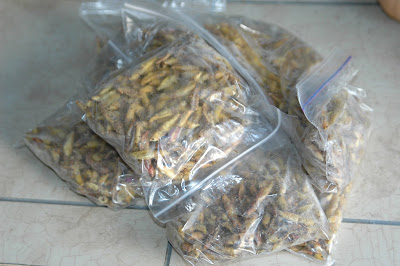 Don’t they look like shrimp?
 The important part is to find out what insects taste like, and in the bigger picture to understand how people can feed themselves within harmony with nature. I’m getting a taste of a market in Kampala. I’m increasing my stock-in-trade.
 Two friends had come by and were up for a tasting, though they were a bit hesitant:


 A couple weeks ago I dropped off the flour at Liberty Elm Diner at 777 Elmwood Avenue in the glorious city of Providence. Liberty Elm is a relatively new establishment and they're multo cool -- not just because they're willing to bake with insect flour. Their food is great, they've got live music, and they're friendly and wiki-enabled. You can learn more about them at
 In fact the diner's baker made the wheat-flour/potato bread both with and without the cricket flour, for comparison's sake. The dark one contains the cricket flour; it was also quite a bit denser. I'm mildly embarrassed to say that I don't yet know exactly how she worked that recipe -- how much flour was called for, and how much cricket flour was used, and did the latter simply replace the usual flour or was added to? Questions like these need answering, but the more important details are that the cricket rolls were very tasty, with a sort of parmesan cheese taste to them; AND that even though the rolls were not officially on the menu, several people ordered and paid for them! Most cool. With a little more effort I could help Providence reach the forefront of entomophagic cities in this country...
  I'd bought them at this table; there was only one such vendor at the market that late afternoon.
 I'm aware that pictures like this are kind of a tacky standard subject for foreign tourists, and I felt a little strange shooting away like this, just as if I was some gawker. But I tried each kind of insect and then bought a second bag for later, and some of these were very tasty. For my money, the best of all were the BIG grasshoppers.
 The conference,
 and grasshoppers were among the best. Unlike most of the other conference-attendees, I tried all of the insects on offer, though several of them weren't fantastic:
  Of these, the ones in the lower right quadrant -- the bedraggled sphinx moth, the rhinoceros beetle, and the longhorn beetle cut off by the edge of the image -- were pretty bad. The Giant Water Bug also was disappointing. But the large crickets (genus Brachytrupes) in the upper right area, and the house crickets on the left side of the plate, were quite good, as were the two varieties specified already. After finishing the great majority of this plate I will admit that I was ready for the vertebrate selections that evening.
 One of the 39 cricket pits housed in an unwalled area the size of a four-car garage -- a concrete circle a meter across and half as high. It's a self-contained cricket utopia (except for the part about being harvested as food, but then the crickets themselves never know about that part). There's plenty of hiding places, food [chicken feed], and water [two plastic water-bottles laid on their sides, with paper towels out of the holes punched to let the capillary action draw the moisture up for the insects to drink -- brilliant in its simplicity!] There's even a handy laying-tray with the right kind of substrate: coconut husks and potting soil. The eggs can hatch in a new pit and thereby start off the next generation. Seven weeks later, harvest time.
 The last day included some papers (including mine, which went pretty well) and group meetings.
 Best of all: after the tour, we lay ourselves on the dry riverbed and watched the hundreds of thousands of cave swifts speeding through the evening air, back to their perches in the cave. Spectacular!! The shots I took didn't do them justice, but a charming Montrealean named Madga sent me some video she had shot. If anyone just has to see it, let me know and I'll try to send it to you.
 Too soon I had to return to Chiang Mai and fly home, to Bangkok, where I wasn't able to see a thing because I didn't plan it into this trip; then Tokyo, where I had sushi in the airport; and back to Chicago, Boston, then home at last to modest, cozy Providence. I'm looking forward to my next trip to Thailand; we'll have to see how soon I'll be able to go.


 [Photo by David Winthrop]